Before any of us were arguing about AI-generated posters and writing, I used to have conversations with friends about artificial intelligence. Mostly the kind we'd grown up watching in movies and on television. If you watched Star Trek: The Next Generation, you probably remember Data, who I always thought was one of the most interesting characters on the show. Here was a machine trying to understand humanity, and often putting up with all sorts of BS from the humans around him. Later, movies like Spielberg's A.I. Artificial Intelligence and Chappie continued that fascination for me.
I think I spent more time imagining a future with Data than worrying about one with Skynet. Although, to be fair, Hollywood gave us plenty of reasons to worry about both.
So when generative AI started becoming available to ordinary people, I wasn't immediately against it. I remember watching Last Week Tonight with John Oliver when he was showing off AI-generated images of himself falling in love with a cabbage, eventually marrying the damn thing. This was before anyone I knew was regularly using these tools, and I thought it was hilarious. I imagine a lot of us did.
And I'll admit something else, I was an early adopter.
I've been a writer for as long as I can remember. People who went to high school with me will probably remember that, and some of my family still have emails I sent home every week while travelling the world. Those emails were essentially journals of my adventures, and some of them have been kept for decades. So writing was never something I felt I needed a machine to do for me.
Visual art, though, was another story. I can't paint, I can't draw, and I certainly couldn't illustrate a book. So I convinced myself of something I hear people say all the time now. I'm not a visual artist, so AI allows me to create art I couldn't otherwise create.
Except, looking back, that wasn't entirely true. I've always had some sense of composition and design. Give me a little time, some licensed photography or artwork, and I can put together a decent poster. I just couldn't create every individual element myself, and for a while AI seemed like a pretty convenient way around that.
In fact, in the earliest days of what eventually became Northern INK Workshop, before we published Born of Boreal Bones, before we'd even settled on the group's identity, some of our banners and promotional artwork were AI-generated. I also remember making a little South Park-style video last year, having some fun with a few friends, complete with music. It was heavily AI-assisted. We weren't hiding that, but we weren't particularly concerned about it either.
So when somebody tells me they use AI because they're not a painter, musician, or writer, I understand where they're coming from. I've made that exact argument myself.
My opinion changed gradually, and a lot of that change came from the people around me.
For the last few years, I lived out in the remote countryside, and most of my regular conversations were with other artists. I belong to countless writing groups, literary communities, and creative platforms, and I've come to believe that artists might be the most AI-allergic people on the planet. I don't have a statistic for that, just years of talking with writers and artists who are overwhelmingly against having their work replaced, imitated, or even assisted by AI.
Of course, there are AI-assisted artists who disagree, and sometimes they push back pretty hard. That's okay. I'm not interested in telling somebody what they can or can't create, particularly if they're honest about how it was made and they're sharing it somewhere that accepts that kind of work. That doesn't mean every creative community has to welcome it. Northern INK Workshop, which I run, doesn't accept AI-generated writing, images, or anything in between.
My own position has evolved to the point where I don't even want grammatical assistance in my personal writing anymore. I write in Frenglish sometimes, my sentence structure isn't always perfect, and I probably break more grammatical rules than I realize. But those things are part of my voice, and I'm not convinced they all need fixing.
There's something I've been telling newer writers since long before AI entered the conversation, and I think it's even more relevant today. You probably can't compete with Stephen King. But here's the thing, Stephen King can't compete with you either.
You probably can't compete with Stephen King. But here's the thing, Stephen King can't compete with you either.
And what I mean by that is fairly simple. Stephen King has his voice, his experiences, his particular way of seeing the world. You have yours. Nobody else grew up exactly where you did, knew all the people you've known, made the same mistakes, or experienced the world in precisely the same way. And if you allow those things into your writing, if you really lean into your own voice rather than trying to sound like somebody you admire, you've got something even the most accomplished writer in the world can't reproduce from personal experience.
Now, AI can imitate writing styles. Sometimes quite convincingly, and I don't think we should pretend otherwise. It can learn from what's already been written, including your own published work, and produce something that resembles it. That's a legitimate concern.
But your voice isn't standing still. The person writing your next book isn't necessarily the person who wrote your last one. We grow, we experience things, we change our minds. I've certainly changed mine about AI, and I imagine the way I write five years from now will reflect plenty of experiences I haven't had yet.
Since moving back into Timmins proper, travelling for meetings, and working with all sorts of people across Canada, I've also realized that the world outside my artistic circles has a very different relationship with AI. Businesses embrace it, entertainment companies embrace it, and plenty of ordinary people see nothing particularly wrong with using it to make a poster, write an announcement, or produce something for an event.
During a recent media tour, I actually had a friendly debate with a media company that embraces AI-generated visuals. I wasn't there to tell them how to run their business, but I did suggest that using AI imagery for posters and event announcements might turn off a growing number of potential viewers.
Their argument was pretty straightforward. Look at our numbers, it works.
And maybe it does. But I remember privately wondering what those numbers might look like with a little artist's grease in there.
Of course, there's another side to this, and as a starving artist myself, I have some sympathy for it. Somebody organizing a small nonprofit event might not have the money to commission a professional artist every time they need a poster. Somebody who doesn't write might need help putting together an announcement. AI gives people access to things they might otherwise have to pay somebody to create, and I understand why that's attractive.
I've even found myself making professionally licensed, non-AI posters for people at no charge, simply because I wanted to help them promote something worthwhile. But that's hardly a solution either. Artists deserve to be paid, and we're already finding ourselves reducing our prices or giving away our work just to compete with the endless supply of AI-generated material.
So what's the solution? I don't know. I really don't.
If you're an artist who needs something outside your own skill set, I'd encourage you to license work, commission somebody, or collaborate with another creative. There's probably somebody in your creative circle who would be delighted to work with you, and you might end up making a pretty good friend in the process.
Now, there's one part of this whole AI debate that really does irk me, and that's the publishing industry's relationship with it.
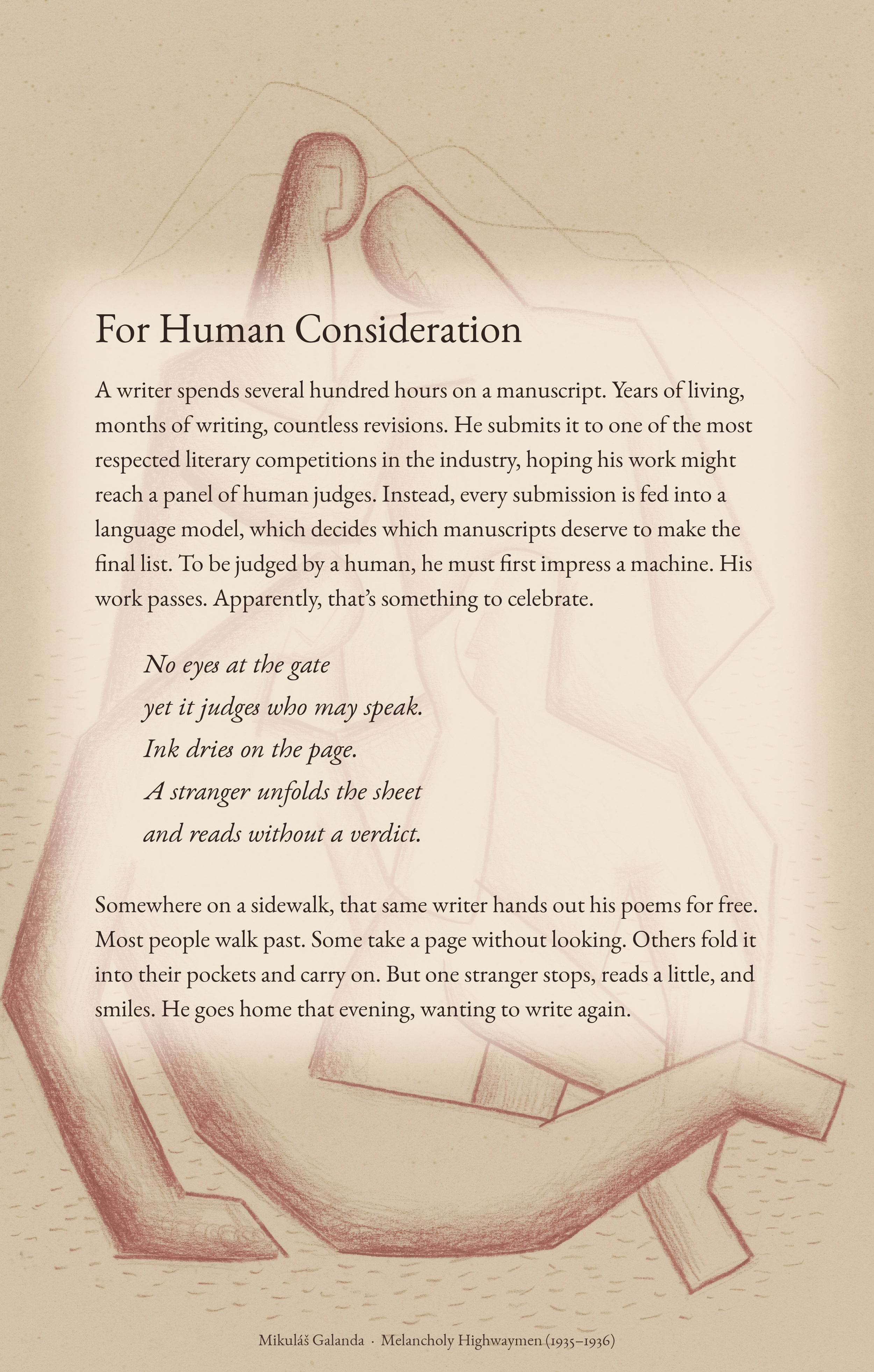
You don't have to look very hard to find publishers, literary magazines, or competitions declaring NO AI ALLOWED. And personally, I'm all for that. But I've started noticing something strange. Some of the same organizations that insist upon human-created writing are perfectly comfortable letting AI evaluate that writing.
Take Blue Denim Press, a Canadian publisher whose submission guidelines say they're not interested in AI-generated manuscripts. In 2025, they participated in a writing competition that used an AI system called Iris to evaluate submissions, including things like style, genre suitability, and commercial potential.
To be fair to Blue Denim Press, they disclosed the use of AI in the competition. Nobody was hoodwinked, and I'm not suggesting they use that same process for their regular submissions. But I still find it a little strange that we're asking writers to produce entirely human-created work while inviting machines to help decide which of those writers deserve recognition.
I still find it a little strange that we're asking writers to produce entirely human-created work while inviting machines to help decide which of those writers deserve recognition.
Then there's the International Impact Book Awards, which, if I may, is an awards platform I'm not particularly fond of to begin with. Their judging process describes a proprietary Literary Metric Assessment System that evaluates complete manuscripts before a human reviewer makes the final decision. They don't provide enough information for me to say whether that system uses a large language model, but I would certainly like to know more about how much of the actual literary evaluation is being done by software.
Especially when writers are paying to have their books considered.
And while we're at it, I'm not particularly fond of judging artistic merit based on commercial potential. I understand that publishers have businesses to run and books to sell, but some of the most important writing in the world was hardly destined to become a bestseller. Anyway, that's probably another debate for another day.
What bothers me is the possibility that we're moving toward a world where writers have to prove their manuscripts were created by humans, only to have those manuscripts evaluated by machines. I think artists are entitled to ask questions about that, particularly when they're paying submission or entry fees.
So, are we in danger of losing something to AI?
I'd be a fool to say no. I think some artists are under considerably more pressure than others. Voice actors, illustrators, graphic designers, and musicians are all dealing with industries that suddenly have cheaper alternatives available to them. Writers aren't immune either, and I'm not going to pretend that having a unique voice automatically protects somebody's livelihood.
But I do wonder about the longer-term effects of all this.
Are people going to start visiting galleries more often because they're tired of scrolling through endless AI-generated pictures? Will live music become more important to audiences as AI-generated music becomes more common? Will readers increasingly reject AI-generated book covers, or become more interested in meeting the actual people behind the books they're buying?
I suspect some of that is already happening, although I don't know how much of it will last.
Writers might have a particularly difficult time demonstrating their humanity. A painter can show you the original canvas, and a musician can pick up an instrument and perform. Sure, a writer can sit on a street corner with a typewriter and demonstrate their skill, but we're hardly going to write entire novels out there.
And I worry about what happens when we start asking writers to prove themselves through keystroke histories, revision records, and other technical evidence. Those things can be useful, but surely we don't want a publishing industry where the first question about a manuscript is whether a computer believes a human wrote it.
I'd rather see writers lean further into their own experiences, peculiarities, and voices. Even the awkward bits. Maybe especially the awkward bits. I don't think every sentence needs to be grammatically perfect, or every poem needs to sound like something an award-winning poet would write. Sometimes the thing that makes a piece of writing memorable is precisely what another editor might have tried to correct.
Sometimes the thing that makes a piece of writing memorable is precisely what another editor might have tried to correct.
And maybe I'm being a little optimistic about the future of human-created art. I certainly wouldn't have said all of this a few years ago, back when I was happily making AI posters and laughing at John Oliver marrying a cabbage.
But that's part of the point, I suppose. People change their minds, and artists change with their experiences. I certainly have.
So yes, I guess this is an anti-AI article, although I don't think the responsibility belongs entirely to artists. The people who publish, promote, purchase, and consume art have a role to play too. If we want human-created art to survive and thrive, we probably need to make sure we're supporting the humans who create it.
And if someday an AI evaluates one of my manuscripts and decides it's human enough, or good enough, to publish, I'm not sure how much satisfaction I'll get from that.
But if a human reader connects with something I've written, even just one humble reader who never leaves a review, never tells anybody about the book, and I never even know they existed, well, I'd rather have that.