An office full of people on Third Avenue can be very good for the lunch counter around the corner and do very little for the shop next door on Saturday afternoon. Ask both owners how downtown Timmins is doing and you could get two different answers. I’d believe them both.
Downtown Timmins · Perspective
What Is a Downtown For Anymore?
Timmins has spent more than a decade looking at smaller storefronts, housing above shops and ways to keep people downtown after an appointment. What have we learned about which of those ideas work here?

In 2014, roughly 3,000 people worked downtown, according to Northern Ontario Business, and the reported vacancy rate was below one per cent. Even then, the Downtown Timmins Business Improvement Area was talking about downtown becoming more of a neighbourhood. Landlords were looking at apartments above shops and ways to divide larger premises. The Urban Park gave people a reason to spend time downtown in the summer. Banks, medical offices and government services brought people in throughout the year. One question was what happened after the appointment. Was there a reason to stay?
Some days, getting in, seeing your doctor and getting home again is exactly what you need from downtown. The BIA describes a district of about 250 businesses employing more than 2,400 people. For a good many people in Timmins, downtown is still the place they have to be on Monday morning.
There are immediate pressures on those streets, too. A shopkeeper worried about crime has to think about who closes up and how that employee gets home. For somebody without housing, the more urgent question may be where they’ll sleep that night. Housing and homelessness matter to me, and I’ve written about them elsewhere. What I want to look at here is a question we’d still face even if everyone had a safe place to sleep and felt comfortable walking down Third Avenue. What do we need these buildings for now, and who can afford to put them to use?
Consider 227 Third Avenue. Bucovetsky’s opened its flagship store on that corner in 1934. After a fire destroyed the store, it was rebuilt and reopened in October 1938. Generations shopped there before Tweed & Hickory closed its doors in January 2015. The following year, the BIA was trying to fill about 10,000 square feet of former retail space. Noella Rinaldo, then the BIA’s executive director, told Northern Ontario Business that entrepreneurs starting out were generally looking for something closer to 700 to 1,000 square feet.
We tend to look at a vacant storefront and assume it means nobody wants to do business there.
Sometimes nobody wants that much storefront.
Dividing a department store sounds reasonable enough from the sidewalk. Somebody still has to pay for the work before they know how many tenants they’ll find or what those tenants can afford in rent.
Different reasons to be downtown
Kenora had a useful starting point. People already came to Lake of the Woods, and the city invested in making it easier to move between the waterfront and its older commercial streets. In 2019, Ontario associated the first three phases of that work with $6.92 million in provincial funding, 513 jobs and $61 million in private investment. I’d want to know how those jobs were counted before drawing conclusions about what the public money bought. But the idea behind the investment is easy enough to understand. Somebody who’s already come for the lake is a much better prospect for a restaurant within walking distance than one they have to get back in the car to find.

Moose Jaw gives people a different reason to make the trip. Its tunnels, trolley tours, heritage buildings and restaurants give a family several things to do in the same part of town. The City reported about $134 million in visitor spending across Moose Jaw in 2024.
For a downtown merchant, the interesting part of that citywide figure is what happens when the tour ends. Do people have lunch around the corner? Do they find another shop on the way back? Timmins has mining, railway and migration stories of its own. If we ever consider building an attraction around one of them, what a visitor could do in the next hour deserves as much thought as what they would pay to get in.

In Nelson, British Columbia, merchants and civic leaders took on Baker Street together. The City records that 70 downtown heritage buildings were restored between 1980 and 1985. There’s a practical difference between one owner fixing up a storefront and a group of neighbours working on the same street. The first owner can improve the premises right up to the property line. The neighbours can start to influence whether somebody walks the length of the block. For Timmins, that raises a useful question about where improvements would do the most good together, particularly for the businesses already there.
And then there’s winter. An attractive pedestrian area in July is one thing. Asking people to spend an afternoon wandering between businesses in February is another. A snowbank at the crossing can turn a short trip into a fairly long one, particularly for somebody using a walker or pushing a stroller. That’s where a clear sidewalk, a place to eat and several errands within a block start to matter more than they might in a summer photograph. A downtown economy can’t depend entirely on the few months when nobody has to think very hard about where to put the snow.
On market Saturdays, the old department store at 227 Third Avenue gives local vendors something the building once struggled to offer: a space small enough to take on. When the BIA arranged a holiday market there in 2021, vendors booked the available spaces in about a week. A Mother’s Day market was advertised there this spring. Now, beneath the old Tweed & Hickory lettering, the window credits Agnico Eagle and invites shoppers back for five Saturdays in November and December. A local maker can sell Christmas gifts on Third without taking on a shop. Somebody looking for a gift has a reason to go downtown on a Saturday. That arrangement is worth something to both of them.
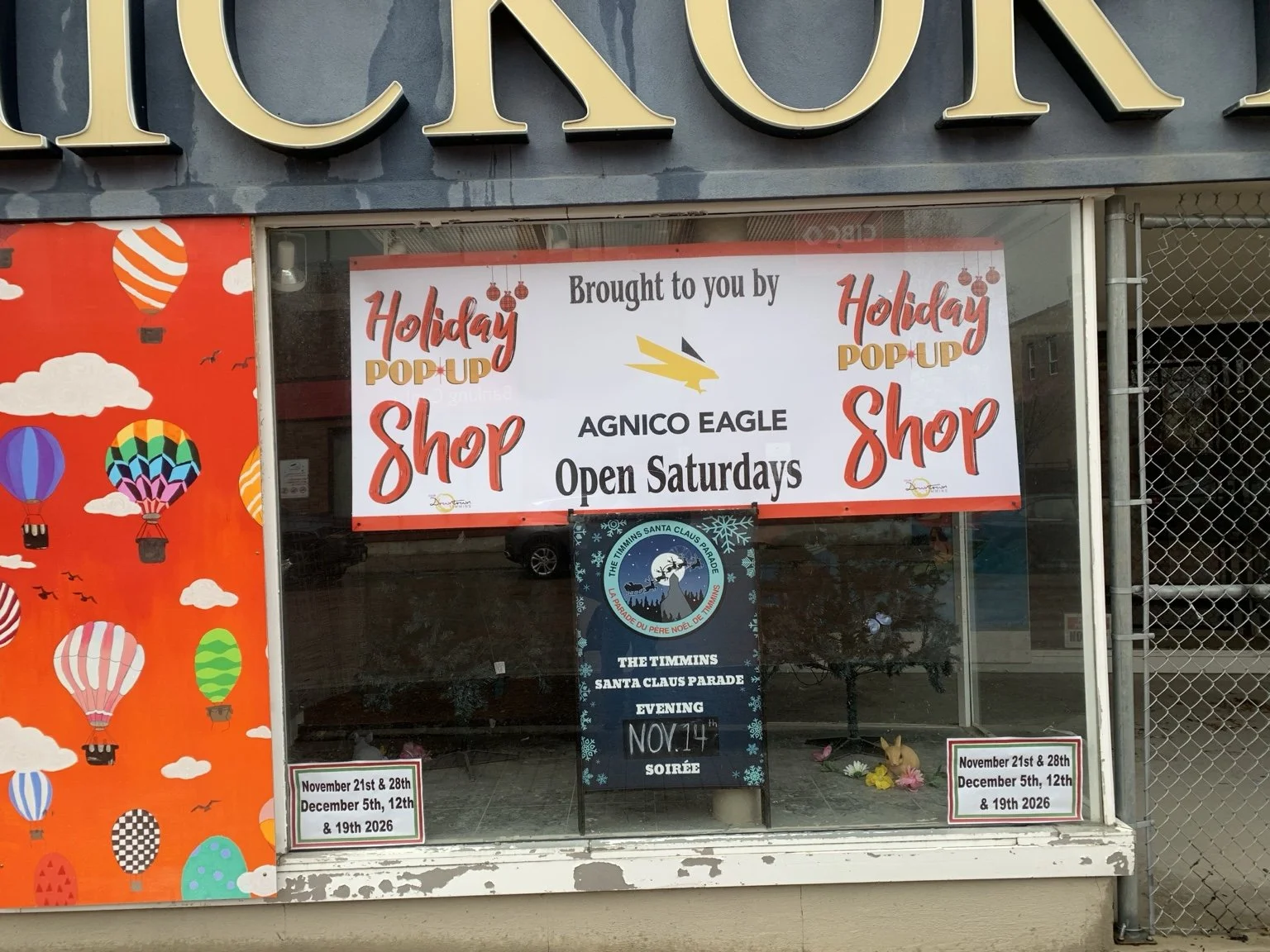
The building is still advertised for sale. Looking ahead to 2027, what would the owners, the BIA and the vendors like to carry forward from those Saturdays if the building changes hands? Whoever considers buying the property has something to learn from the people already using it.
Who could live upstairs?
It’s been a hard decade to oversee a downtown shopping district. Malls and big-box stores had already changed where people shopped. Online shopping changed how often they needed to make the trip at all. Then COVID disrupted the routines of people who still came downtown to work, eat or run errands. A BIA has little say over where people buy their clothes or how often they go into the office. It can, however, look at what stands in the way of somebody making a home above a shop.
Parking was one place the Downtown Timmins BIA put its attention. In the Ontario Business Improvement Area Association’s 2026 report, Turning the Lights On, Cory Robin, executive director of the Downtown Timmins BIA, described the BIA’s push to ease parking requirements that older commercial buildings with no driveway had little hope of meeting.
In May 2025, council removed the off-street parking requirement for permitted upper-floor uses above ground-floor businesses in the General Commercial zone. Robin also described the Timmins fire department working with owners to find room for a safe second exit, sometimes making use of the laneway behind a building.
For an owner considering an apartment upstairs, the parking change removes one obstacle. The cost of the renovation and the rent somebody can afford still have to meet. The City offers grants covering up to half of eligible upper-storey residential work, to a maximum of $30,000. What that buys depends a great deal on the building. The figures that would tell us most are the cost of getting an apartment ready, the share the grant covered and the monthly rent once somebody moved in.
We often talk about what new residents might do for the businesses downstairs. People already living downtown are entitled to look at it the other way around. Can they get to work, pick up a prescription and carry groceries home?
Can they afford to stay in the neighbourhood as it improves?
A person who can do those things within a few blocks has a pretty good answer to what a downtown is for.
What would Timmins gain?
Any discussion about what to spend downtown ought to begin with whose money it is. Council approved a $310,000 operating budget for the Downtown Timmins BIA in 2026, with a special levy on eligible properties in the district. The City’s Downtown Community Improvement Plan is a separate program, and its eligible areas extend beyond central Timmins. If we want to know what has gone into a particular block, we need to know which properties received support, how much was actually paid and what happened once the work was finished.
Take a storefront improvement. The owner can tell us whether the grant made it possible to do work they’d been putting off for years. The tenant can tell us whether the premises became easier to do business in, and what it took to keep the shop open through construction. A customer may remember one thing about the whole project: they can get through the door with their walker now. All three answers belong in an account of what the money accomplished.
The City has good reason to keep a sidewalk passable in February. When the case for a project is that it will bring in customers, create housing or help a business stay open, it’s fair to go back and see how things turned out. A resident of Schumacher or South Porcupine can reasonably ask what the wider community gains from an investment on Third Avenue. A downtown business owner paying the levy can just as fairly ask that we count what businesses in the district already contribute.
We’ve been talking about the future of downtown Timmins for more than a decade. What interests me now is what we’ve learned from the things we’ve already tried, what’s worth doing next, and what the rest of Timmins would gain if we got it right.
Sources & further reading
- Northern Ontario Business: the last day at Tweed & Hickory (2015)
- TimminsToday: holiday market bookings at 227 Third Avenue (2021)
- Downtown Timmins strategy reporting (2014)
- Downtown Timmins storefront vacancies (2016)
- 227 Third Avenue property listing
- Ontario: Kenora downtown investment (2019)
- City of Moose Jaw: 2024 tourism spending
- OBIAA: Turning the Lights On (2026)
- Bucovetsky’s store history
- Downtown Timmins BIA district profile
- Porcupine Art Club: Mother’s Day market
- City of Nelson: downtown heritage restoration
- City of Timmins: May 2025 bylaws, including 2025-9150
- City of Timmins: Downtown Community Improvement Plan
- City of Timmins: 2026 Downtown BIA budget and levy
- Pierre Filion: Canadian mid-size city downtowns