I was an hour early for a meeting about a sewage lagoon. Fortunately, Joe Polowy, the City of Timmins project coordinator, let me in anyway. Joe has become something of the face of this project, beard and all. I'd written about Bob's Lake before, and not especially kindly, so I was interested in hearing what had changed. I also wanted some time with the people doing the work before the room filled up and everybody had questions of their own.
Richard Rowe, a senior biologist with FRi Ecological Services, took me through the information boards. He was generous with his time and patient with my questions, which I appreciated because I had quite a few of them. We discussed the lagoon, the proposed wastewater diversion, and what might happen to the site afterward. Richard also took responsibility for the written comment forms. He told me he intended to respond to every question and comment within thirty days. I wrote that down. Thirty days isn't very long when you're talking about a sewage lagoon that's been around for more than sixty years. Mind you, he was promising answers, not a completed sewer project. I'll be interested to see how that goes.
Before the public arrived, I also ran into Lester Cudmore, the former Timmins fire chief, who began telling me about a meeting held in Timmins in 1912. I wish I could tell you more about it. We were getting somewhere when the doors opened at five o'clock, and that was the end of our history lesson for the evening. Lester and I will have to finish that conversation another day.
The public information session was held Wednesday, October 21, at Whitney Arena. I had expected something a little more formal, perhaps somebody standing at the front explaining the project while the rest of us waited for an opportunity to ask questions. Instead, people wandered between displays, talked with the engineers and city staff, and talked with each other. It was closer to a community mixer than a public presentation, which suited me just fine. Scott Collin, the city's Manager of Engineering, was there, along with Codey Munshaw, the civil engineer and project manager from EXP Services. Joe and Richard continued making their way around the room. Nobody seemed particularly interested in hiding behind a table.
I think I spoke with about 85 percent of the people who attended. That's not an official statistic. I didn't stand at the door counting heads. But I got around, and nearly everyone I met seemed to have some connection to Bob's Lake, either living there now or having lived there at some point. I didn't notice another reporter, either. Of course, I'm an amateur, so perhaps that means there were no journalists there at all.
People had come for different reasons. Some were relieved that something finally appeared to be happening. Others were pleased with what they were hearing but weren't ready to believe it would actually happen. After decades of discussions and maintenance work, I can understand that. Chris Blais, a homeowner in the area, wanted to know whether the project would affect his property. He asked his question, received an answer, and afterward we had a chance to talk. I also met Linda and Tim, a couple who have lived in the area since 1996. They liked what they were hearing, but after thirty years they were ready to see the work actually done. There were people from Voices of Timmins and Porcupine, asking questions and listening to what others had to say.
One woman arrived with questions that had something of a pitchfork shape to them. Some went beyond what the engineers and environmental people could reasonably answer. Still, she was given room to ask them. That was one of the things I liked about the evening. The people representing the city and the project seemed willing to have conversations, including conversations that didn't fit neatly onto an information board. And people did talk. Not everyone was happy. Not everyone was convinced. But I didn't encounter much of the hostility we sometimes associate with municipal meetings. There was a good deal of curiosity, some understandable skepticism, and quite a bit of local history. For a meeting about sewage, it was a pleasant evening.
The proposal itself is fairly straightforward to explain, although carrying it out is another matter. The city intends to divert wastewater from the Bob's Lake system toward the Whitney/Tisdale treatment system, eventually allowing the old lagoon to be decommissioned. The lagoon dates back to around 1960 or 1961. Whitney's sewage treatment plant opened in 1974. Four years later, an Acres Consulting watershed study considered pumping sewage from Bob's Lake to Whitney as an option worth investigating.
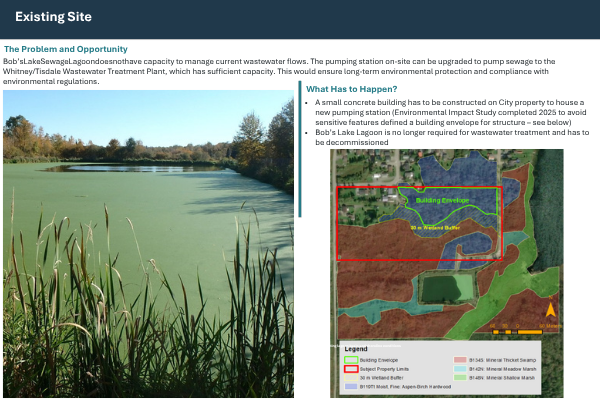
I want to be careful with that history. The 1978 study did not produce an approved construction project that the city simply forgot to build. It identified an option. But the fact that the option was being discussed nearly fifty years ago is still worth remembering. We've spent a great deal of time and money keeping the existing system going in the years since. There was sludge dredging in 2019. There were inspections, monitoring requirements, capacity concerns, and various efforts to extend the useful life of infrastructure that had already served the community for decades.
Some of that work was necessary. You can't simply stop dealing with sewage while waiting for a better plan. The expression I kept hearing was buying time. I've been thinking about that. Were we buying time toward a solution, or were we paying to keep the problem going for another few years? I suspect the answer changed depending on which year you were asking about.
The current project feels different to me because it proposes an actual way out of the old arrangement. In August 2025, the city awarded EXP Services a contract worth approximately $749,250 for engineering, design and contract administration. That figure is not the cost of building the new system. It's the cost of preparing and overseeing the work. That's an important distinction. The city's project information points toward design work continuing into fall 2027. Construction, funding, and the eventual decommissioning are still ahead of us. Nobody at Whitney Arena was unveiling a completed sewer line.
I came away with the impression that the people working on the project know where they want to go. I also got the impression that some of them weren't especially familiar with the older history I'd been digging through, particularly the discussions that took place long before the current team became involved. I don't hold that against them. The engineers working on this project weren't the people making decisions in 1978. But I think that history matters, especially when we're trying to understand why residents might have trouble getting excited about another set of plans. The city has been buying time for a long while. I'd like to think we're now buying something more useful.
The proposed diversion is one question. What happens to the lagoon afterward is another. The information boards presented four possibilities. The city could remove and grade the lagoon area for parkland or recreation. It could retain the basin for wet-weather overflow. It could naturalize the site into a passive wetland. Or it could leave things largely as they are.
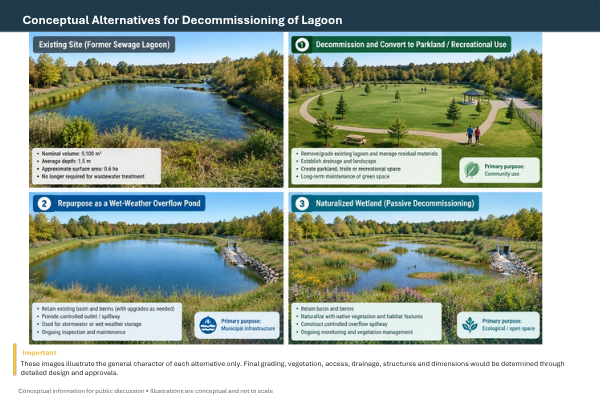
The preliminary evaluation favoured the wetland option on five of six criteria, with capital cost receiving a more moderate assessment. That option would retain the basin and berms, introduce native vegetation and habitat, and include a controlled spillway, monitoring and maintenance. In other words, passive doesn't mean walking away and hoping for the best. It also doesn't mean that decades of sewage use can somehow be erased by planting a few things.
I didn't speak to anyone who seemed particularly interested in turning the place into a park. That's only my impression of the people I met, not a survey of the neighbourhood. The engineers also didn't seem to see much practical need for keeping the lagoon as an overflow pond. The naturalized wetland was the option that seemed to make the most sense to people. I had a feeling the project team was gently steering us in that direction. I could be wrong. Nobody announced a preferred outcome to me, and the final decision hasn't been made. But the presentation made a reasonable case for it, and the people I spoke with seemed receptive.
I find the idea appealing myself. Not because I imagine the old lagoon becoming some untouched piece of wilderness. It won't be that. But after sixty years of serving a purpose nobody particularly enjoys discussing, perhaps the site could serve a different one. We'll see what the environmental work and the final decisions allow.
The curious thing about Bob's Lake is that the lagoon is only part of its history. I was reminded of that repeatedly throughout the evening. I spoke with Steve Meunier, who has since won the Ward 4 council race, and he told me about a legendary walleye he'd caught. Naturally, there was photographic evidence. Finding it took a while. He scrolled through what appeared to be hundreds of fish photographs on his phone before finally locating the one he wanted. He did find it, and I have no reason to doubt there were plenty more stories attached to the photographs we passed along the way. I suspect he has more fish stories than either of us had time for that evening.
Outside the meeting, Norm Dwyer told me he grew up in Porcupine and was certain his was the last generation to swim and play at Bob's Lake. That caught my attention. I've spent so much time looking at the lagoon through engineering reports and municipal records that it's easy to forget there was a lake people remember swimming in. Norm also mentioned that his crowd growing up had a name: the Porcupiners.
John Curley remembered those days, too. Curley, who was still the Ward 2 councillor when we spoke, talked about Bob's Beach, the swings, school picnics and swimming meets at the lake. We wandered through a few other subjects as well. At one point he said something that stayed with me: “The city is my ward.”
I liked that. I don't live beside Bob's Lake. I don't own property there. My interest in what happens to it isn't particularly complicated, though. It's part of Timmins, and I care what happens in Timmins. Curley's remark put that feeling into a few words. He has since lost the municipal election. We'd talked about that possibility at the arena, and he didn't seem overly concerned about finding ways to occupy himself if he was no longer on council. He told me he wanted to stay active and wasn't interested in sitting around at home. I imagine he'll find something to do.
The conversation also reminded me how much of a place's history lives with the people who were there. Engineering reports can tell us when a system was built, what its capacity was, and what somebody proposed doing about it. They don't tell us much about swimming meets, or which fish somebody caught, or why a particular patch of ground still matters to a family that moved away years ago. That's one of the reasons I enjoy talking to people. I came to Whitney Arena with a folder's worth of questions about wastewater. I left with several more subjects I'd like to know something about. And I still hadn't heard the end of Lester's story from 1912.
I don't want to make the evening sound like a celebration of a project that's already finished. It isn't finished. There is engineering to complete, construction to fund and carry out, and an old lagoon that will eventually need to be dealt with properly. The people who have lived with this situation for decades have every reason to watch what happens next. My earlier criticism of the city's long history with Bob's Lake still stands.
But I also think it's worth saying when people are doing something well. Joe Polowy let me in early. Richard Rowe took the time to explain the environmental options and committed to answering the written comments. Codey Munshaw and Scott Collin were available to speak with residents. Questions were asked and, from what I saw, taken seriously. I appreciated that.
I hope the city continues approaching the project this way as it moves from drawings and discussions into the more difficult business of getting things built. I'll keep following it. I have a few questions left myself, and I suspect the residents do too.
As for Lester, I still want to hear what happened at that meeting in 1912. And I owe him fifty cents for the bottle of water I took from the fridge.